Choosing Between a Sole Proprietor and a Private Company in South Africa (2026 Edition)
Starting a business in South Africa often begins with one important decision: should you operate as a sole proprietor or register a private company (Pty) Ltd? Understanding the difference between these two business structures is essential because it affects your personal liability, tax obligations, credibility, and long-term growth potential.
A sole proprietor is the simplest business structure. The business and the owner are legally the same, meaning the owner is personally responsible for all debts and obligations of the business. In contrast, a private company (Pty Ltd) is a separate legal entity registered with the Companies and Intellectual Property Commission (CIPC). This structure provides limited liability protection, meaning the company—not the individual owner—is responsible for most business debts.
For many South African entrepreneurs, the choice between these structures depends on factors such as risk tolerance, tax planning, funding opportunities, and business growth plans. A sole proprietorship may be suitable for small, low-risk operations or side businesses, while a private company is typically better for businesses that plan to expand, hire employees, or attract investors.
This guide explains the key differences between a sole proprietor and a private company in South Africa, including registration requirements, legal liability, tax considerations, and when it makes sense to convert your business into a Pty Ltd company. If you are starting a business or thinking about formalising your operations, understanding these structures will help you choose the option that best protects your finances and supports your future growth.
Sole Proprietor vs Private Company in South Africa
Key Features of a Private Company
Separate legal entity
A private company (Pty) Ltd is recognised in South African law as a separate legal entity, meaning the company exists independently from its shareholders and directors. This allows the company to own property, enter into contracts, and conduct business in its own name. Because the company has its own legal identity, its rights and obligations are distinct from those of its owners.
Formation and registration
To operate as a private company, the business must be registered with the Companies and Intellectual Property Commission (CIPC). Once registered, the company receives a registration number and must also be registered with the South African Revenue Service (SARS) for tax purposes. The incorporation process typically includes submitting a Memorandum of Incorporation (MOI) and reserving a company name.
Ownership and management
A private company may have one or more shareholders who own the company and one or more directors responsible for managing it. In many small businesses, the same person may act as both shareholder and director, but the law still treats the company as a separate entity from the individual.
Limited liability protection
One of the most important features of a private company is limited liability. Shareholders are generally not personally responsible for the debts or legal obligations of the company. Their financial risk is typically limited to the amount invested in the business, which protects their personal assets from creditors.
Taxation and compliance
A private company is taxed as its own taxpayer and must submit corporate tax returns to SARS. Companies must also maintain proper financial records and may be required to prepare annual financial statements depending on their size and turnover. Because companies are separate legal entities, they are subject to stricter compliance and reporting requirements than sole proprietorships.
Continuity and growth potential
Unlike a sole proprietorship, a private company has perpetual existence. This means the company can continue operating even if shareholders or directors change. The structure also makes it easier to attract investors, raise funding, and expand operations as the business grows.
Key Features of a Sole Proprietor
Legal status
A sole proprietorship is the simplest form of business structure in South Africa and is owned and operated by a single individual. The business is not a separate legal entity, which means the owner and the business are legally the same. Because of this, the proprietor personally assumes all responsibilities, profits, and liabilities associated with the business.
Formation and registration
Starting a sole proprietorship is relatively straightforward. Unlike a company, it does not need to be registered with the Companies and Intellectual Property Commission (CIPC). In many cases, the owner can begin trading immediately. However, the individual must still register with the South African Revenue Service (SARS) for tax purposes and comply with any industry-specific licenses or permits that may apply.
Ownership and management
The sole proprietor has complete control over the business. All decisions—from daily operations to long-term strategy—are made by the owner alone. This allows for faster decision-making and flexibility but also means the owner carries full responsibility for the success or failure of the business.
Liability
One of the most important characteristics of a sole proprietorship is unlimited personal liability. Because there is no legal separation between the owner and the business, personal assets such as property or savings may be used to settle business debts or legal claims if the business cannot meet its obligations.
Taxation and compliance
A sole proprietorship is not taxed as a separate entity. Instead, all profits and losses are reported on the owner’s personal tax return. This can simplify tax administration because the business income is treated as part of the individual’s taxable income. However, if turnover exceeds certain thresholds, the business may still need to register for additional taxes such as VAT or employer taxes if staff are hired.
Continuity
A sole proprietorship does not have perpetual existence. The business is directly tied to the owner, meaning it ends if the owner stops trading, sells the business, or passes away. Unlike a registered company, the structure does not continue independently of the individual running it.
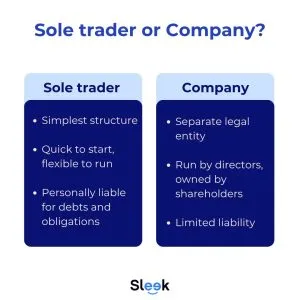
Key Differences Between a Private Company and a Sole Proprietor
| Aspect | Private Company (Pty Ltd) | Sole Proprietor |
|---|---|---|
| Legal entity | Separate legal entity with limited liability | Not separate—owner and business are the same |
| Formation | Requires CIPC registration, MOI and name approval | No formal CIPC registration; register with SARS for tax |
| Setup cost & time | Higher cost and longer process | Low cost; can start quickly |
| Liability | Limited to shareholders’ investment | Unlimited—personal assets are at risk |
| Management | Directors manage; shareholders appoint them | Owner manages and makes all decisions |
| Taxation | Corporate tax (28 %) and dividends tax | Personal income tax rates |
| Compliance | Annual financial statements; possible audits | No statutory financial statements or audits |
| Continuity | Perpetual succession; easy to add shareholders | Ends when owner stops or dies |
| Capital raising | Easier to attract investors and loans | Limited ability to raise capital |
| Best for | Businesses seeking growth and liability protection | Freelancers, side‑hustles and small-scale operations |
Naming and Branding
- Sole proprietor: free to choose any business name; you can trade under your own name or a fictitious name without registration. However, trade name reservations via the CIPC can provide branding protection.
- Private company: the name must be approved by the CIPC and aligned with the MOI
- Decision‑making and governance
- Sole proprietor: you make all business decisions unilaterally.
- Private company: decisions are made by directors and documented through resolutions.
- Financial reporting and audits
- Private companies must prepare financial statements and, depending on turnover, may require an audit.
- Sole proprietors have no statutory reporting requirements but should keep proper records for SARS.
- Tax and VAT obligations
- Sole proprietors include business profits in personal tax returns and may need to register for VAT if turnover exceeds R 3.2 million.
- Private companies pay corporate tax at 28 %, file company returns and withhold dividends tax.
- Choosing the Right Structure
- When deciding between a sole proprietor and a private company, consider your risk tolerance, growth goals, capital requirements, and administrative capacity. If you are testing a business idea or freelancing, the low-cost, flexible structure of a sole proprietorship may suit you. However, if you aim to scale, seek investors, or limit personal liability, a private company offers protection and professionalism but comes with higher compliance obligations.
- Step‑by‑Step: How to Register a Sole Proprietorship
- Even though no formal CIPC registration is required, there are still essential steps to operate legally:
- Choose a trading name (optional) – You may trade under your legal name or register a fictitious name via CIPC for branding.
- Register for tax – Notify SARS that you’re self‑employed and obtain a taxpayer reference.
- Register as a provisional taxpayer (if applicable) – If you expect your income to exceed the basic tax threshold, register as a provisional taxpayer.
- Check VAT requirements – Register for VAT if turnover is likely to exceed R 1 million in any 12‑month period; voluntary registration is also possible.
- Register with PAYE, UIF and COIDA – If employing staff, register with SARS for PAYE, with UIF for unemployment insurance, and with the Compensation Fund for injuries.
- Obtain permits – Depending on your industry (food, health, trade), acquire necessary municipal licences or permits.
- Set up accounting and record‑keeping – Maintain detailed records of income, expenses, invoices and bank statements.
- File tax returns – Submit your SARS ITR12 return annually and file VAT returns if registered
Register Your Company the Smart Way
Stop operating informally. Protect yourself and build credibility with a Private Company (Pty) Ltd. Admin Boss helps entrepreneurs across South Africa register their companies quickly and affordably.
✔ Fast CIPC Processing
✔ 100% Remote Service Across South Africa
✔ Trusted Support from Admin Boss
Thousands of South African entrepreneurs register companies every year. Make sure yours is done correctly.