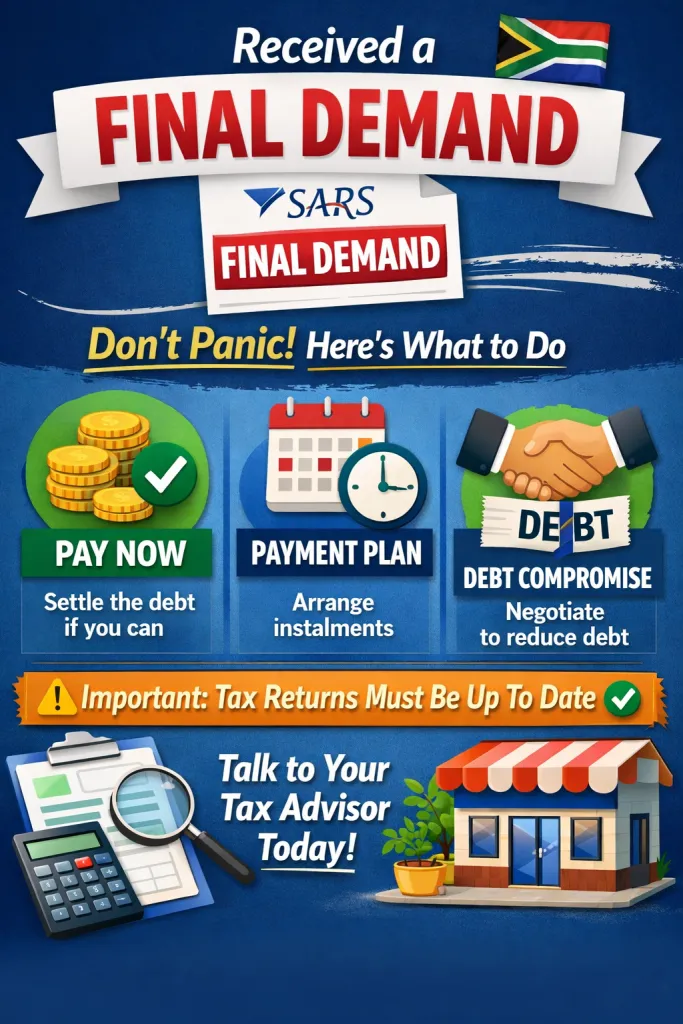
What to do if SARS issues a Final Demand for debt — a guide for small businesses💼
About that Final Demand
Getting a Final Demand from SARS is stressful. It’s a formal escalation in SARS’s debt-collection process and gives you a short legal window to act before stronger enforcement steps begin (garnishee orders, civil processes, or outsourcing to collectors). If you are in a financial position to pay the debt, do so immediately — that’s the fastest way to stop further interest and enforcement.
1) First practical steps (do these immediately) ✅
- Check the letter is genuine. SARS final demands include your tax reference number, case number and are sent via official channels (eFiling, SARS email or post). Don’t click suspicious links in SMS/mail — if unsure, log into your eFiling account and check correspondence there.
- If you can pay, pay now. Use eFiling or your bank to pay the full amount shown on the Statement of Account — that will stop the process quickest.
- If you cannot pay in full, don’t ignore it. Read the rest of this guide — there are formal options (payment arrangement, compromise) but they require action and documentation.
2) Option A — Payment arrangement (defer / instalments) 📅
A payment arrangement lets you pay the full debt over time (instalments) or in a lump sum at a later date. SARS now allows taxpayers to request and manage payment arrangements via eFiling, where the system can auto-simulate a plan (default 6 months) and let you accept or propose different terms. The eFiling pathway and the official guide outline the step-by-step process.
Key things to know about payment arrangements:
- SARS runs validation checks. One common blocking issue is outstanding returns — SARS will generally only consider a payment arrangement if your returns are up to date for the tax types involved. Make sure all outstanding returns are submitted before applying.
- You may need to supply supporting documents. eFiling will prompt you if SARS requires documents showing your financial position.
- Defaulting risks termination. If you don’t keep to the agreed schedule, SARS can terminate the arrangement and resume collection, with interest continuing to run.
How to start (quick checklist):
- Log into eFiling → SARS Correspondence → open the Final Demand / Statement of Account.
- Click Payment Arrangement (or “Deferral of Payment Arrangement”) and follow the simulation.
- Upload any requested documents and confirm your first instalment/payment method (EFT, debit order, etc.).
3) Option B — Debt compromise (concession / offer to settle) 🤝
If your business truly cannot pay and the debt cannot be reasonably repaid over time, you may apply for a compromise (also called a concession or offer to settle). SARS considers these selectively and will request a detailed Collections Information Statement and supporting evidence showing inability to pay. The process is document-heavy and approval is not guaranteed.
What SARS typically requires for a compromise:
- A written request and signed application.
- Detailed financial statements, cash-flow forecasts, bank statements and proof of attempts to raise funds.
- Evidence that the proposed compromise is in the best interests of the fiscus compared with alternatives (e.g., liquidation).
- Submission of any outstanding tax returns (SARS will want your affairs up to date).
Bottom line: a compromise can reduce what you owe, but it’s a formal process that takes time and strong supporting evidence.
4) Common blockers & mistakes to avoid ⚠️
- Not submitting outstanding returns. SARS often refuses or blocks payment-arrangement or compromise requests until returns are up to date. Submit returns first.
- Missing documentation. Be ready to show financials, bank statements and a cash-flow plan.
- Pretending a fake letter is real (or vice versa). Verify correspondence in eFiling. SARS will not demand immediate payment via strange payment portals — use official channels.
5) Practical tips for small businesses 👍
- Talk to your tax practitioner or accountant — they can lodge arrangements, prepare Collections Information Statements and negotiate more effectively.
- Keep communication records with SARS (dates, reference numbers, names) — helpful if disputes arise.
- Prioritise tax returns: keeping returns up to date preserves access to relief options.
- Consider cash-flow solutions (short-term financing, director loans) only after evaluating cost vs benefit — paying SARS sooner often costs less than long-term interest and enforcement fees.
Closing — act now, but act smart 🚀
A Final Demand from SARS is urgent — if you can pay, pay immediately to avoid interest and enforcement. If you can’t, prepare your returns, gather financial documents, and either apply for a payment arrangement via eFiling or discuss a compromise with SARS — ideally through a tax practitioner. Quick, documented action gives you the best chance of keeping the business running and the debt manageable. 💪
Read more about SARS compliance..or contact us today for more information.