COIDA: What Lucky Learned After One Workplace Accident
Lucky runs a small business with a few employees and, like many owners, he used to think COIDA was just another admin task 😅. Then one ordinary workday changed everything. One of his employees got injured while doing the job, and Lucky suddenly realised that workplace compliance is not only about ticking boxes — it is about protecting people, protecting the business, and avoiding costly delays. The good news is that COIDA has clear rules for registration, reporting, returns, and payments, so business owners can stay on the right side of the law.

Why Lucky’s Company Should Register for COIDA
1) It gives the business legal protection ✅
As soon as a business employs one or more workers, it must register with the Compensation Fund to cover employees for injuries and occupational diseases at work. The official portal says employers with one or more employees are required to register, and the employer-registration guidance says registration should happen within seven days after the first employee is employed.
2) It protects employees when something goes wrong 🛡️
COIDA exists so that workers can receive support when they are injured on duty or contract an occupational disease. In practice, this means the Compensation Fund can help with medical expenses and compensation for loss of wages, depending on the case. That protection matters for small businesses because one accident should not become a financial disaster for the employee or the employer.
3) It helps Lucky stay compliant and build trust 📄
A registered employer can also receive a Letter of Good Standing once the required fees are paid. That can be important when dealing with clients, contractors, or tenders. The Compensation Fund also makes clear that employers must keep their details updated and notify changes to their business within seven days.
What Happens If One of Lucky’s Employees Is Injured?
Imagine one of Lucky’s employees slips on a wet surface while carrying equipment. The first step is simple: the employee must report the injury immediately to the employer or supervisor. From there, the employer has a legal duty to report the injury to the Compensation Fund within seven working days of receiving notice. If it is an occupational disease, the report must be made within fourteen days.
Lucky must then make sure the correct forms are completed and sent in. The injured employee should take the completed W.CI.2 Part B form to the doctor, and the doctor’s First Medical Report and any Progress or Final Medical Reports must be submitted as well. If the employer does not cooperate, the worker can report the matter at a provincial office or nearest Labour Centre.
The important part for Lucky is this: doing nothing is not an option. When a claim is handled properly, the employee gets the support the law provides, and the business avoids unnecessary problems later. In some cases, if the employee is off work for a serious injury, wage-related compensation may come into play as well.
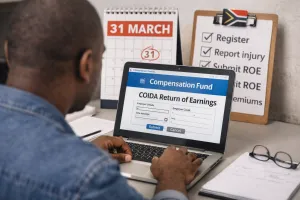
When and How Lucky Should Submit Returns to COIDA
The deadline matters 🕒
The law requires employers to submit the Return of Earnings before 31 March each year, unless the Director-General communicates a different date. The Compensation Fund’s current online portal also says the ROE application will be available again from 1 April 2026, and that failure to submit ROEs is against the law and penalties may be charged.
How Lucky should submit the return 💻
Lucky can submit the return online through the Compensation Fund portal or use the manual route when required. The online portal specifically directs employers to the ROE submission system, and the official guidance says employers can also submit earnings statements by hand delivery or to the Compensation Fund by post where applicable. The return must reflect the employer’s details, employee numbers, and earnings information accurately and completely.
If Lucky is selected for audit, the Compensation Fund may request supporting documents such as payroll records, financial statements, and the completed ROE form. That is why keeping clean, up-to-date payroll records is not optional — it makes compliance faster and much less stressful.
How Lucky Should Pay COIDA Premiums
Every year in April, the Compensation Fund sends a notice of assessment telling employers how much they must pay, and the payment date is usually within 30 days of the notice. The assessment is based on workers’ earnings and the risk linked to the type of work being done. Employers must use the reference details on the assessment notice when paying.
Lucky can pay in the ways listed by the Compensation Fund: by cheque, by direct debit at an ABSA branch, or by internet banking using the official client code and reference number shown on the deposit slip. The online portal also notes that payment must be made within 30 days to avoid interest.
Lucky’s Lesson for Small Business Owners
Lucky’s biggest lesson was simple: COIDA is not paperwork for the sake of paperwork. It is part of running a responsible business. Register early, report injuries on time, file returns correctly, and pay assessments before the deadline. That is how a small business stays protected, professional, and ready for growth. ✨
Need help with COIDA registration, returns, or compliance? Don’t wait until an injury or penalty forces the issue. Visit the Admin Boss COIDA service page today and get the support your business needs now. ⚠️