Preparing for the 2026 Personal Income Tax Season in South Africa

Summary: South Africa’s 2026 tax season covers the 2025/26 tax year (1 March 2025 – 28 February 2026). SARS will again use auto‑assessments for many individual taxpayers. Provisional taxpayers have different timelines from salaried employees. This post explains expected filing dates, lists the documents each taxpayer type should gather, provides guidance on cryptocurrency and capital gains tax, outlines taxable income, and summarises employer responsibilities.
1. Filing season dates for 2026
- Auto‑assessments: Budget 2026 FAQs note that auto assessments will issue around 21 July 2026 and that any shortfall must be paid by 20 October 2026. SARS will officially confirm the dates in its annual notice (published in the first half of the year).
- Non‑provisional (salaried) taxpayers: Based on SARS patterns and guidance from tax practitioners, the 2026 filing season for individuals is expected to open early July 2026 and close around 23 October 2026. These dates may shift slightly; check SARS announcements.
- Provisional taxpayers: Continue submitting provisional tax estimates. The second provisional payment for the 2025/26 tax year fell on 28 February 2026, with a voluntary “top‑up” by 30 September 2026. The final ITR12 return for provisional taxpayers is due 31 January 2027 (expected).
- Trusts: Trust tax return submissions typically run from late September to 19 January of the following year.
2. Documents to gather by taxpayer type
2.1 Salary earners
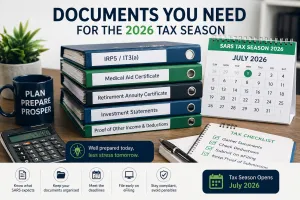
Salary earners receive remuneration through payroll. To complete their tax return, they should gather:
- IRP5/IT3(a) certificates from all employers. From February 2026 SARS requires employers to include a valid income‑tax reference number on every IRP5; eFiling rejects certificates without it.
- Medical scheme tax certificate and receipts for qualifying medical expenses not covered by the scheme.
- Retirement annuity contribution certificates.
- Travel allowance or company car: keep a logbook showing business and private kilometres; collect fuel, maintenance and insurance receipts.
- Interest and dividend certificates from banks or investment providers.
- Documents showing capital gains or losses, rental income, or other taxable income.
2.2 Commission earners
Commission earners (where commission exceeds 50 % of remuneration) can claim business‑related deductions. They should prepare:
- IRP5/IT3(a) from their employer.
- Detailed logbook for business travel and receipts for fuel, maintenance, licence fees and insurance.
- Proof of business expenses such as cellphone and laptop depreciation (invoices), home‑office expenses (apportionment calculations and utility invoices), entertainment receipts (names and purpose of meetings), and bank statements showing bank‑charge expenses.
- Medical and retirement certificates as for salary earners.
2.3 Sole proprietors and freelancers (independent contractors)
Sole proprietors (business owners who trade in their personal capacity) and freelancers must file a provisional return and provide more documentation:
- Financial statements or bookkeeping records showing income, expenses and net profit. Maintain invoices and receipts for all business income and expenses.
- Bank statements for the business account to support bank‑charge claims.
- Asset depreciation records (invoices for laptops, phones, equipment) and calculations apportioning personal vs. business use.
- Vehicle logbook and receipts for travel costs.
- Home office expenses: calculations showing the percentage of the home used for work; utility and rent/bond statements; a letter confirming you work from home.
- Medical and retirement certificates as above.
2.4 Freelancers earning commissions (e.g., agents, consultants)
Freelancers paid on commission should follow the guidance for both commission earners and sole proprietors. In addition:
- Ensure provisional tax is submitted twice a year with accurate estimates of taxable income.
- Keep contracts and invoices for all clients to verify income.
3. Cryptocurrency (crypto‑asset) tax considerations
SARS defines a crypto asset as a digital representation of value traded or stored electronically and secured through cryptography. Normal income tax rules apply: taxpayers must declare gains or losses from crypto transactions in the year they occur. Important points:
- Income vs. capital: Crypto‑asset gains may be taxed as revenue (ordinary income) or as capital gains. Determination depends on the nature of the activity—trading for profit is typically treated as revenue, whereas long‑term investment may fall under the Capital Gains Tax (CGT) regime.
- Mining, exchanges and barter: Income from mining crypto, exchanging crypto for currency or other assets, or receiving crypto as payment for goods/services must be included in taxable income.
- Record keeping: SARS expects taxpayers to keep records of acquisition cost, sale proceeds, trading fees and dates. Third‑party crypto‑asset service providers may be required to report transactions to SARS, making non‑declaration risky.
4. Capital Gains Tax (CGT) updates for 2026
Budget 2026 raised several CGT exclusions:
- Primary residence exclusion: For individuals, the first R3 million of gain on the sale of a primary residence is now excluded from CGT (previously R2 million).
- Annual exclusion: The annual CGT exclusion for natural persons or special trusts increased from R40 000 to R50 000; in the year of death the exclusion rose from R300 000 to R440 000.
- Small business relief: For a qualifying small business disposed of by a natural person aged at least 55, the lifetime CGT exclusion increased from R1.8 million to R2.7 million.
CGT applies when you dispose of assets (property, shares, crypto assets, etc.). Only a portion of the capital gain is included in taxable income (currently 40 % for individuals). Keeping accurate records of the acquisition cost and improvements is essential.
5. What SARS considers taxable income
SARS lists the following amounts as part of taxable income:
- Employment income: salaries, wages, bonuses, overtime pay, taxable fringe benefits, allowances and certain lump sums.
- Business or trade profits (or losses).
- Income from trusts when you are a beneficiary.
- Directors’ fees.
- Investment income: interest and foreign dividends.
- Rental income or losses.
- Royalties.
- Annuities and pension income.
- Certain capital gains.
6. Employer obligations (PAYE and IRP5)
Employers play a crucial role in the personal tax cycle. Budget 2026 emphasises new obligations:
- EMP501 reconciliation: Employers must submit their annual PAYE/EMP501 reconciliation through eFiling or e@syFile during the 1 April – 31 May 2026 window.
- Issue IRP5/IT3(a) certificates: Employers must issue IRP5 certificates to employees within 60 days of the end of the tax year (around 29 April 2026 for a February year‑end). Certificates must include the employee’s income‑tax reference number; eFiling will reject submissions without it.
- Register employees: If an employee doesn’t have an income‑tax reference number, employers must register them via ITREG or BundleReg before issuing IRP5 certificates.
- Monthly EMP201 returns: The PAYE, Skills Development Levy and UIF contributions must be paid and reported via the monthly EMP201 by the 7th of each month (earlier if the 7th falls on a weekend/public holiday). For the February 2026 return, the due date is 6 March 2026.
- Keep employees above the National Minimum Wage (NMW): From 2 March 2026, the NMW is R30.23 per hour. Paying employees below this rate disqualifies the employer’s Employment Tax Incentive claim for that month
When to submit
To submit a personal income tax return in South Africa, taxpayers must ensure they meet the basic SARS filing requirements and have the correct supporting documents ready. Individuals usually need to submit a tax return if they earn income from multiple sources, run a business or freelance, receive rental or investment income, or disagree with a SARS auto-assessment. Salaried employees must typically provide documents such as their IRP5 certificate from their employer, medical aid tax certificates, retirement annuity certificates, and statements showing investment or interest income. Freelancers, commission earners and sole proprietors must also keep invoices, bank statements, and records of business expenses to support their income declarations. SARS determines each year who must file based on income thresholds and the information they receive from employers, banks and other institutions, and if you disagree with an auto-assessment you must submit your own tax return to correct it.
If you have administrative penalties for previous tax years, it usually means SARS has identified outstanding tax returns or late submissions. Administrative penalties are issued under the Tax Administration Act when a taxpayer fails to submit required returns, and they can range from R250 up to R16 000 per month depending on taxable income, continuing for up to 35 months while the return remains outstanding. The most important step is to submit all outstanding tax returns immediately, because penalties continue to accumulate until the taxpayer becomes compliant. Once the returns are filed, you may request a Request for Remission (RFR) through SARS eFiling if there was a valid reason for the late submission, and SARS may reduce or remove the penalty after reviewing the request.
Don’t let outstanding tax returns or penalties continue to grow. If you need help submitting your tax return, fixing past returns, or dealing with SARS administrative penalties, the Admin Boss team can assist you quickly and professionally. 👉 Get expert help today
Conclusion
The 2026 personal income tax season will bring both familiar processes and significant updates. Salaried employees should gather IRP5s, medical certificates and any investment statements well ahead of the expected July opening date. Commission earners and sole proprietors must maintain detailed records and logbooks to support their deductions. Crypto‑asset investors need to declare gains or losses as part of taxable income, and new CGT exclusions will offer relief when selling a primary residence or disposing of a small business. Employers should ensure they reconcile PAYE early, register all employees for tax, and issue IRP5 certificates with valid tax reference numbers. Preparing early will help taxpayers avoid penalties and ensure a smoother auto‑assessment process.
⚠️ Don’t Risk SARS Penalties This Tax Season
Thousands of South Africans file their tax returns incorrectly every year. Admin Boss helps individuals and businesses submit accurate SARS tax returns, avoid penalties, and stay compliant.
✔ Fast tax return assistance
✔ SARS compliance support
✔ Help with crypto, capital gains & extra income
✔ Trusted support for South African taxpayers
Why Choose Admin Boss?
- Affordable tax services
- Trusted by South African entrepreneurs
- Fast online assistance
- Expert SARS guidance