CIPC Annual Return Fee Calculator & Compliance Guide – Admin Boss
Updated for the latest CIPC annual return fees and compliance rules (2026).

Overview: Why Annual Return Compliance Matters in 2026
Filing your company’s annual return may feel like a simple administrative chore, but it’s much more than a tick‑box. Every South African company, close corporation and NPC must file an annual return with the Companies and Intellectual Property Commission (CIPC).
Failure to file on time leads to late penalties that accrue daily and can eventually get your company deregistered.
Admin Boss created this interactive CIPC Annual Return Fee Calculator to help small businesses understand their filing obligations, estimate outstanding fees and stay compliant. This page is your one‑stop guide for CIPC annual return fees, penalties, deadlines, and compliance tips.
Compliance is especially important in the era of AI‑powered search. Platforms like Google’s AI Overviews, ChatGPT and Perplexity extract answers directly from trustworthy, structured content.
By presenting clear headings, concise answers, updated data and structured FAQ schema, Admin Boss ensures that both humans and AI agents understand and trust our content.
What Is a CIPC Annual Return?
A CIPC annual return is a mandatory filing required by the Companies Act. It confirms that your entity is still trading and updates CIPC’s register with your latest contact details and beneficial ownership information. Every private company (Pty Ltd), public company, close corporation (CC) and non‑profit company (NPC) must file an annual return. Even dormant companies must file to avoid deregistration.
When Is Your Annual Return Due?
Your filing deadline is tied to your anniversary date – the date your company was incorporated.
CIPC requires filing within 30 business days of this date; missing the deadline triggers late penalties.
For example, if you incorporated on 15 June 2020, your annual return is due about 27 July each year (30 business days after the anniversary date, accounting for weekends and public holidays).
Why Use This Tool?
- Accurate Fee Estimates: The calculator uses the official CIPC fee schedule and penalty rules to estimate your outstanding fees.
- Structured Guidance: It follows AI‑friendly content guidelines – clear H2/H3 headings, short paragraphs, Q&A sections and FAQs – improving visibility in AI search results.
- Trust and Authority: We cite reputable sources for every statement and link out to official CIPC guides, accounting practices and compliance experts to build trust.
- Actionable CTA: At the end of the page you’ll find a call‑to‑action (CTA) inviting you to let Admin Boss handle your annual return filings, boosting compliance and organic traffic.
Official CIPC Fee Bands (2025/2026)
The CIPC fees depend on your entity type and annual turnover. Below is a summary of the official schedule for 2025/2026 based on CIPC and industry sources:
| Entity type | Turnover bracket | Standard fee | Late filing penalty (per year) |
|---|---|---|---|
| Private company (Pty Ltd) | R0 – R1 million | R100 | R150 |
| R1 m – R10 m | R450 | R600 | |
| R10 m – R25 m | R2 000 | R2 500 | |
| Above R25 m | R3 000 | R4 000 | |
| Close corporation (CC) | R0 – R50 m | R100 | R250 |
| R50 m+ | R4 000 | R4 150 | |
| Non‑profit company (NPC) | All turnover | R30 | (NPCs usually aren’t penalised) |
Source: CIPC fee guidance compiled from InfoDocs support and ClearComply’s annual return guide.
How Fees Are Calculated
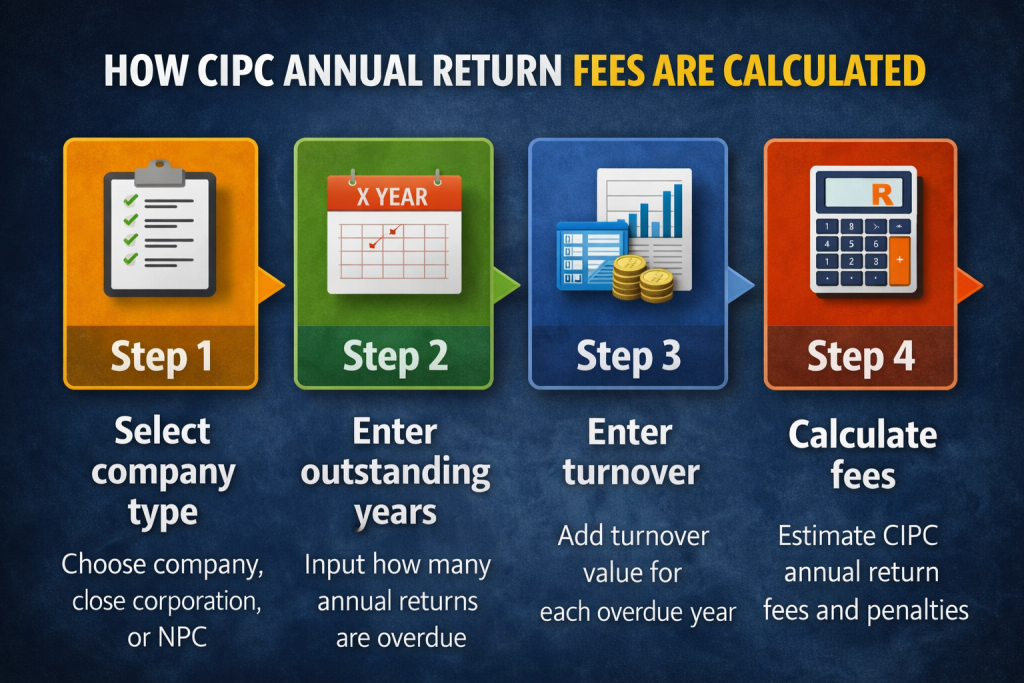
CIPC calculates your annual return fee based on your entity’s reported turnover. The fee remains the same even if the company was dormant (R0 turnover is treated as “up to R1 million”).
Late Penalties
Missed deadlines trigger penalties that accumulate daily after the 30‑business‑day filing window closes. The penalty is a fixed amount based on turnover bracket, plus the standard filing fee. Beyond penalties, non‑compliant companies face additional consequences:
- Non‑compliance flag: Your company will be marked as non‑compliant on the CIPC register, visible to banks, suppliers and business partners.
- Administrative lock‑out: You cannot process director changes, name changes or other filings until the annual return is up to date.
- Deregistration notice: Persistent non‑compliance leads to deregistration and loss of legal status.
CIPC Annual Return Fee Calculator

Filing Step‑By‑Step
1. Gather Your Information
- Company registration number
- CIPC customer code and password
- Annual turnover figures per outstanding year
- Beneficial ownership details for individuals who own or control 5 %+ of shares/votes
- Financial statements or a Financial Accountability Supplement (FAS) if required by your Public Interest Score
2. Log into the CIPC Portal
Go to BizPortal and log in using your customer code. Select the company and complete the annual return form.
3. Complete the Beneficial Ownership Declaration
Since 2023, you must declare all beneficial owners when filing your annual return. Failure to do so will prevent the return from being accepted.
4. Upload Financial Documents
Depending on your Public Interest Score, you may need to upload either audited financial statements or a Financial Accountability Supplement. Small companies with low Public Interest Scores often qualify for the FAS.
5. Pay the Filing Fee
Pay the applicable fee (plus any late penalties) online. Save the confirmation receipt as proof of compliance.
Understanding Late Penalties and Deregistration
It’s tempting to delay filing when your company is dormant or experiencing cash‑flow issues. However, the costs and risks of non‑compliance far outweigh the filing fee:
- Daily penalties: Penalties accrue from the first day after the due date. The longer you wait, the higher your bill.
- Non‑compliance flag: CIPC publicly lists non‑compliant companies. This can scare away suppliers, lenders and potential partners.
- Administrative lock‑out: No other documents can be lodged until returns are up to date. If you need to change directors or address details, you must first file all outstanding returns.
- Deregistration notice: After continued non‑compliance, CIPC publishes your company in the Government Gazette as a deregistration notice. You have a limited window to file all returns and pay fees before deregistration.
- Final deregistration: A deregistered company loses legal status and directors may become personally liable for debts.
Recovering from Non‑Compliance
If you’ve missed your filing deadline, act immediately:
- Still within the 30‑day window: File now and pay the standard fee.
- Flagged as non‑compliant: File all outstanding returns and pay accumulated fees and penalties to remove the flag.
- Deregistration notice: File all outstanding returns and pay penalties before the gazette deadline to cancel deregistration proceedings.
- Already deregistered: Restoration requires paying all outstanding fees and court involvement. The process is costly and time‑consuming.
FAQ
What is a CIPC annual return?
A CIPC annual return is an annual filing with the Companies and Intellectual Property Commission confirming that a company or close corporation is still operating. It updates CIPC’s register with current address, directors/members, and beneficial ownership details.
When do I have to file my annual return?
Your annual return is due within 30 business days of your company’s anniversary date (the date of incorporation). The deadline is unique to each company. Missing the window triggers daily late penalties and non‑compliance flags.
How much does the CIPC annual return cost?
For private companies, fees range from R100 to R3 000 depending on turnover; for close corporations it is R100 or R4 000; and for NPCs it’s R30. Late filing penalties increase the total cost.
What happens if I miss my annual return deadline?
Consequences include daily penalties, a non‑compliance flag on the CIPC register, administrative lock‑out (you cannot file other documents), publication of a deregistration notice, and ultimately being struck off the register.
Can Admin Boss file my annual return for me?
Yes. Admin Boss offers affordable, professional annual return filing and compliance monitoring services. We’ll prepare your return, ensure your beneficial ownership declaration is complete, and file it before the deadline. Our service includes reminders and support so you never miss another filing.
Conclusion
Filing your CIPC annual return is not optional. It protects your company’s legal standing and prevents costly penalties and deregistration. The Admin Boss CIPC Annual Return Fee Calculator empowers you to estimate fees, understand deadlines, and plan your compliance strategy.
⚠️ Are Your CIPC Annual Returns Outstanding?
Late or missing annual returns can lead to penalties and even company deregistration. The experts at Admin Boss assist businesses across South Africa with fast and affordable CIPC Annual Return submissions.
✔ Fix My Annual Returns Now✔ Remote service across South Africa • ✔ Fast turnaround • ✔ Affordable pricing
If you’re overwhelmed or short on time, let Admin Boss handle your annual returns. Click the CTA above, and our team will ensure everything is filed correctly and on time.
Stay compliant, save time, and grow your business with confidence — that’s the Admin Boss promise. ✅