Admin Boss Business Glossary: Key Terms and Definitions
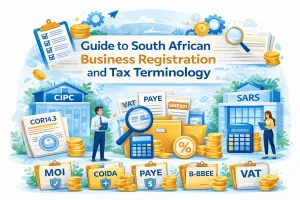
Starting and running a business in South Africa involves interacting with several regulatory authorities including the Companies and Intellectual Property Commission (CIPC), the South African Revenue Service (SARS), the Department of Employment and Labour, and the Master of the High Court. Each of these institutions uses specialised terminology and forms such as EMP201, EMP501, VAT201, IT12, and COR39, which can be confusing for entrepreneurs and new company directors.
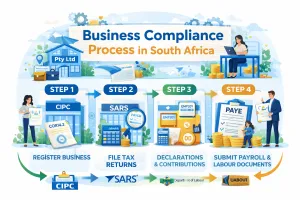
This glossary created by Admin Boss explains the most important company registration, tax compliance, payroll, and governance terms used in South Africa. It is designed to help business owners quickly understand concepts such as Private Companies (Pty) Ltd, Memorandum of Incorporation (MOI), PAYE payroll taxes, beneficial ownership requirements, and CIPC annual returns. For example, employers must submit a monthly EMP201 declaration to SARS to report payroll taxes such as PAYE, UIF and SDL, ensuring the correct amounts deducted from employee salaries are paid over to SARS.
Whether you are registering a new company, maintaining compliance with CIPC, submitting tax returns to SARS, or applying for certificates like COIDA Letters of Good Standing or Tax Clearance, this page provides clear explanations of the most common compliance terms used in South African business administration.

Company and Business Structures
- Private Company: A company that may not offer its shares to the public and has restrictions on share transfers. It must have at least one director and one incorporator (who may be the same person or a juristic entity).
- Close Corporation (CC): A CC is an older type of South African business entity used by smaller companies. It is run by its members (who must be natural persons, up to 10 members max) and, under the current Companies Act, no new CCs can be registered.
- Sole Proprietor: A sole proprietor is an individual who owns and operates a business alone, without forming a separate legal entity. The sole proprietor uses personal funds and assets and personally assumes all the risks and liabilities of the business.
- Non-Profit Company (NPC): An NPC is incorporated for public benefit or communal objectives (e.g. cultural, social, community projects). Its income and assets cannot be distributed to members or directors; instead, all resources must be used to advance the company’s stated public-purpose goals.
- Personal Liability Company (PLC): A PLC is a special company where the directors (including past directors) share joint and several liability with the company for any debts or obligations incurred during their tenure. This is unlike a normal private company and is typically used in professions requiring directors to accept personal liability for business debts.
- Joint Venture: A joint venture is a business arrangement in which two or more parties (individuals or companies) combine resources to pursue a specific project or goal. The parties share the venture’s profits, losses and management according to their agreement, without forming a separate company entity.
- Holding Company: A holding company is a company whose main function is to own a controlling interest (usually a majority of shares) in one or more other companies (subsidiaries). It typically holds and manages those investments but does not itself produce goods or services.
- Shareholder: A shareholder (or member) is an individual or entity that legally owns one or more shares in a company. This ownership is often evidenced by a share certificate, which is a signed document certifying the shareholder’s ownership of a specified number of shares. Shareholders have rights such as voting and dividends proportional to their shareholding.
- Share Register: The share register (or shareholder register) is the company’s official record of all shareholders and their shareholdings. It lists each shareholder’s name, address, and the number and class of shares they hold. The share register is the authoritative record of a company’s ownership structure and is required by law.
Governance, Officers and Documents
- Director: A director is any member of a company’s board of directors as defined under Section 66 of the Companies Act 71 of 2008. Directors are responsible for managing the company and must exercise care, skill, and diligence in their duties.
- Public Officer: A Public Officer is the person appointed by a company (or other juristic person) to act as its official tax representative under the Income Tax Act. This officer is responsible for handling the company’s tax affairs (e.g. PAYE, VAT) and communicating with SARS on the company’s behalf.
- Memorandum of Incorporation (MOI): The MOI is the founding constitutional document of a company in South Africa. It establishes the company’s identity, outlines its powers and objectives, and sets the rules governing its internal operations and governance under the Companies Act.
- Annual Financial Statements: These are the formal yearly financial reports of a company, including the income statement, balance sheet, cash flow statement, and notes. South African law requires all companies to prepare and file annual financial statements, often in iXBRL format for CIPC, to demonstrate transparency and compliance.
- Annual Returns (CIPC): Annual Returns are the statutory filings that every registered company and close corporation must submit to CIPC each year. These online returns update CIPC on the entity’s basic financial data (like turnover) and contact details; failing to file an annual return on time results in penalties.
- Share Certificate: A share certificate (or stock certificate) is a legal document signed by a company’s directors that certifies a shareholder’s ownership of a specified number of shares. It serves as formal proof of a shareholder’s stake in the company and is recorded in the company’s share register.
- Beneficial Ownership: Beneficial ownership refers to the individuals who ultimately own or control a company. South African law defines a beneficial owner as a natural person who directly or indirectly exercises effective control over the company. Companies are required to disclose their beneficial owners for transparency and anti-corruption purposes.
- B-BBEE Affidavit: A B-BBEE affidavit is a sworn statement used by qualifying small businesses (turnover under R10 million) instead of a formal B-BBEE certificate. It is signed by a Commissioner of Oaths and, once issued, it serves as proof of the company’s Broad-Based Black Economic Empowerment (B-BBEE) status for procurement and compliance.
- Central Supplier Database (CSD): The CSD is a central government database of organisations, institutions, and individuals that can supply goods or services to the public sector. Managed by the National Treasury, it serves as a single source of verified supplier information for all government entities, streamlining procurement and ensuring suppliers meet registration and tax requirements.
CIPC Registration and Forms
- CoR 14.3: A CoR 14.3 is the business registration certificate issued by CIPC when a company is incorporated. It provides legal proof of the company’s registration and status as a separate legal entity under South African law.
- CoR 39: CoR 39 is the CIPC form for “Notice of Change of Directors”. It must be filed with CIPC within 10 business days whenever a company’s board of directors changes (for example, when a director resigns or a new one is appointed).
- CoR 40.5: CoR 40.5 is the CIPC form used to apply for reinstatement of a deregistered close corporation. A deregistered CC (for example, one that failed to file returns) can file a CoR 40.5 with the required fee to restore its legal status and resume business.
- CK2: For close corporations, CK2 is the form used to register an amended founding statement. This is filed when the CC’s membership or management changes (for instance, if a member resigns), updating the official records of the CC’s members with CIPC.
- RAV01: RAV01 is the SARS Registration, Amendments and Verification form for VAT. Vendors use the RAV01 to confirm and update their VAT registration details (such as annual turnover and address) with SARS. It is part of the VAT compliance process to ensure the vendor’s registration status is accurate before issuing a tax invoice.
- CIPC eServices: CIPC eServices is the online portal offered by CIPC for company and IP transactions. Through eServices (accessed with a customer code), users can register private or non-profit companies (with standard MOI), file annual returns, reserve or change names, amend directors/members, and download certificates (like B-BBEE certificates or MOIs) electronically.
- BizPortal: BizPortal is the South African Government’s integrated business registration portal, launched by the DTIC and CIPC. It allows new entrepreneurs to register a private company and simultaneously obtain related services in one place (such as a tax reference number, UIF and Compensation Fund registration, domain name, and B-BBEE certificate). BizPortal streamlines the business start-up process across multiple agencies.
Tax, SARS, and Financial Obligations
- SARS (South African Revenue Service): SARS is South Africa’s national tax authority, responsible for collecting taxes and enforcing tax law. It administers all types of taxes (income tax, VAT, customs duties, etc.) and provides services like eFiling to help taxpayers meet their obligations.
- Pay-As-You-Earn (PAYE): PAYE is the system where employers deduct employees’ income tax from each salary payment and pay it to SARS. This ensures that the employee’s tax liability is settled incrementally as earnings are paid, rather than in a lump sum after year-end.
- Value-Added Tax (VAT): VAT is an indirect tax levied on the consumption of goods and services. Registered vendors charge VAT (currently at a 15% standard rate) on taxable sales and may claim credits for VAT paid on business inputs. The net VAT payable to SARS is the difference between output VAT charged and input VAT paid in a tax period.
- UIF (Unemployment Insurance Fund): UIF provides short-term unemployment benefits (and related maternity, parental, and illness benefits) to qualifying workers. Employers and employees each contribute 1% of the employee’s gross salary to the fund. The Department of Labour administers UIF, which is financed via this payroll tax.
- COIDA (Compensation for Occupational Injuries and Diseases Act): COIDA is the law (Act 130 of 1993) governing workers’ compensation for workplace injuries and diseases in South Africa. It requires most employers to register with the Compensation Fund (or RMA for certain sectors) and to submit an annual Return of Earnings. The COIDA Return of Earnings is the employer’s declaration of total remuneration paid to employees, used to calculate the contribution (assessment) fee.
- RMA (Rand Mutual Assurance): RMA is a licensed mutual insurance company created under COIDA to administer workers’ compensation for specific high-risk industries (mainly mining, metals, and related sectors). Like the government-run Compensation Fund, RMA collects contributions and pays benefits to employees under its coverage.
- CIDB (Construction Industry Development Board): CIDB is a schedule 3A public entity established by Act 38 of 2000. It oversees and regulates South Africa’s construction industry by grading contractors, setting standards, and promoting skills development. Its goal is to improve the industry’s performance, capacity, and integrity in construction procurement.
- Personal Income Tax: This is the tax on individuals’ total income (salaries, interest, rental, etc.). In South Africa, residents are taxed on worldwide income and non-residents on local-source income. Personal income tax is a major revenue source for government. SARS requires individuals to file an annual tax return (ITR12) or accepts an auto-assessment based on third-party data.
- Company Tax: Company tax (corporate tax) is the income tax on a company’s profits. South African resident companies pay tax on worldwide profits at the corporate tax rate (about 27–28% currently). Companies must file an annual income tax return (ITR14) and may submit audited financial statements to SARS.
- Tax Clearance Certificate (TCC): A TCC is an official SARS document confirming that a taxpayer’s tax affairs are in order (i.e. all returns have been filed and liabilities paid). It is required for large transactions such as foreign exchange transfers or tenders. A bank or government agency may ask for a TCC to ensure compliance.
- Tax Debt Compromise: Under the Tax Administration Act, SARS can agree to a tax debt compromise, whereby it accepts a reduced payment as full and final settlement of a taxpayer’s debt. This option is available when a taxpayer cannot pay the full tax liability and meets certain hardship criteria. SARS will require full disclosure of assets, liabilities, and income to consider a compromise.
- Tax Payment Arrangement: A tax payment arrangement (also called a deferred payment arrangement) is an agreement between SARS and a taxpayer to pay an outstanding tax liability in instalments. When approved, it allows a financially distressed taxpayer to settle tax debt over time (often without additional penalties) while remaining compliant. Unlike a debt compromise, a payment arrangement does not reduce the total tax owed, but it does ease cash flow.
- RAV01: The RAV01 is SARS’s “Registration, Amendments and Verification” form for VAT. Vendors use the RAV01 to verify or update their VAT registration details (such as turnover and contact information) with SARS. It must be completed when requesting changes to VAT registration data or when SARS performs verification checks on a vendor’s record.
- E-Filing: SARS eFiling is the online portal where taxpayers and practitioners can manage tax interactions. Through eFiling, users can register for taxes, submit returns (for income tax, VAT, PAYE, etc.), make payments, and communicate securely with SARS. It replaces paper filings and allows convenient 24/7 access to tax services.
- EMP501: EMP501 is the Employer Reconciliation Declaration form that all South African employers must submit to SARS (usually twice a year). It reconciles the total annual employees’ tax (PAYE), Skills Development Levy (SDL), and Unemployment Insurance Contributions (UIC) declared during the year (via monthly EMP201s) with the totals on the IRP5/IT3(a) certificates issued to employees. The EMP501 ensures that what was deducted and paid matches what was reported and certified.
- EMP201: EMP201 is the monthly Employer Declaration form for PAYE, SDL and UIF (UIC). Employers submit an EMP201 each month to SARS for each payroll period, indicating the total tax (PAYE), levy, and UIF contributions due on that month’s salaries. These monthly EMP201 submissions feed into the EMP501 reconciliation at year-end.
- VAT201: VAT201 is the Value-Added Tax return form that VAT-registered vendors must submit to SARS, typically on a two-monthly cycle (or annually for annual-filing vendors). It reports the vendor’s output VAT (charged on sales) and input VAT (paid on purchases) for the tax period, determining the net VAT payable to or refundable from SARS. (Vendors can file VAT201 via eFiling.)
- VAT217: A VAT217 is a SARS Notice of Assessment for VAT. It is issued to a vendor when SARS generates an estimated VAT assessment (for example, if the vendor failed to file a VAT201 on time). The VAT217 shows the amount of VAT SARS has assessed as due, which the vendor must pay if they do not dispute the assessment.
- ITA34T (IT34): For trusts, SARS issues an assessment notice called ITA34T (often shortened to IT34) after a trust’s return is submitted. This document shows the trust’s calculated tax for the year, indicating any amount payable or refundable by the trust. The ITA34T is the official income tax assessment for trusts.
- Personal Income Tax Auto-Assessment: SARS may automatically calculate (“auto-assess”) an individual’s income tax based on third-party data (from employers, banks, medical schemes, etc.). The taxpayer will receive a pre-populated assessment. If the taxpayer agrees with the auto-assessment, no further action is needed; otherwise they must file their own ITR12 with corrected information. (Auto-assessment applies only to qualifying non-provisional taxpayers.)
- IT12 (ITR12): IT12 refers to the annual income tax return filed by individuals (the ITR12 form). Every taxpayer who must file personal income tax submits an ITR12, declaring all sources of income, deductions, and credits for the year. The completed ITR12 determines the final tax payable or refundable for the individual.
- IT14 (ITR14): IT14 is the income tax return filed by companies. Each company registered with SARS (automatically when incorporated) must file an ITR14 (often called “company tax return”) every year to report taxable income and calculate corporate tax. The company’s annual financial statements are usually submitted alongside the IT14.
Labour and Compliance
- Unemployment Insurance Fund (UIF): The UIF provides short-term unemployment benefits, maternity/paternity benefits, and illness/disability benefits to qualifying employees. It is administered by the Department of Labour and funded by a payroll tax: employers and employees each pay 1% of the employee’s remuneration.
- Compensation for Occupational Injuries and Diseases (COIDA): COIDA is the legislation (Act 130 of 1993) that provides compensation for workers injured at work or who contract occupational diseases. Most employers must register with the Compensation Fund or RMA, and submit an annual Return of Earnings detailing total payroll, which determines their COIDA assessment contribution. A Letter of Good Standing under COIDA certifies that an employer’s contributions and returns are up to date, and is often required to bid on contracts or tenders.
- Return of Earnings (COIDA): Under COIDA, every registered employer must file an annual Return of Earnings with the Compensation Fund. This declares the total earnings paid to all employees for the year. The fund uses this information to calculate the employer’s compensation contribution, which finances work-injury benefits.
- Letter of Good Standing (COIDA): A COIDA Letter of Good Standing is a certificate issued by the Compensation Fund indicating that an employer’s COIDA returns and payments are up-to-date. Clients and government agencies often require this letter to prove that a contractor is compliant with worker compensation laws.
- Department of Employment and Labour: The Department of Labour (now Department of Employment and Labour) is the national department responsible for regulating labor and employment matters. It enforces laws on wages, working conditions, and worker safety, and administers social insurance funds like the UIF and COIDA Compensation Fund. (It also handles workplace disputes and skills development programs.)
Regulatory Agencies
- South African Revenue Service (SARS): SARS is South Africa’s revenue authority responsible for collecting all national taxes and customs duties. It provides guidance and systems (like eFiling) to help taxpayers comply with tax laws across income tax, VAT, PAYE, etc.
- Companies and Intellectual Property Commission (CIPC): CIPC is the government agency under the Department of Trade, Industry and Competition that oversees company and intellectual property registrations. It implements the Companies Act by processing registrations of companies/CCs, maintaining company registers (names, directors, annual returns), and enforcing compliance.
- Master of the High Court: The Master of the High Court is an official within the Department of Justice who oversees the administration of deceased estates, insolvent (liquidation) estates, and trusts. The Master’s office ensures that a deceased person’s assets are correctly wound up for heirs and that the trusts are properly registered and administered
Need Help With Business Compliance?
Admin Boss helps South African entrepreneurs stay compliant with CIPC and SARS. Register your company, fix compliance issues, or get help with tax registrations quickly and affordably.