SARS Debt Relief & Tax Dispute Resolution for Businesses in South Africa | Admin Boss

Admin Boss helps South African businesses resolve SARS tax debt and correct SARS assessments where the numbers are wrong (for example after an audit, verification, or automated assessment outcome). We focus on practical, compliant solutions: renegotiating payment terms where the debt is valid, and using the formal dispute channels where SARS has raised an incorrect assessment or penalty.
A key operational reality for companies is that SARS expects the business to have an authorised representative in place—typically the Public Officer (as the company’s “registered representative” for SARS interactions). If the Public Officer/registered representative is not correctly registered and active, it can delay submissions, dispute actions, and debt relief applications.
Admin Boss’s workflow is designed for business decision-makers: we confirm your representative setup, review your SARS debt position and compliance, map the best remedies (debt relief and/or dispute routes), and then issue a clear quote with scope and expected deliverables.
Who this service is for
This service is built for SMEs, mid-market companies, and larger organisations dealing with any of the following:
- Cash-flow pressure where the tax debt is accepted as correct, but the business needs a structured instalment plan.
- Incorrect assessments, adjustments, penalties, or interest (for example: disputed VAT adjustments, PAYE penalties, corporate income tax assessments, understatement penalties, or administrative non-compliance penalties).
- SARS collection risk where you need to protect operations while following due process—especially where you intend to dispute the liability and need to apply for suspension of payment.
Business tax types covered
AdminBoss supports debt relief and disputes across the main business-facing tax types and related levies that commonly drive business debt profiles, including:
- Corporate Income Tax (CIT), VAT, and Employees’ Tax (PAYE)
- Skills Development Levy (SDL) and Unemployment Insurance Fund (UIF) dispute work where SARS dispute channels apply (noting that SARS indicates restrictions on disputing certain statutory interest items, particularly for UIF/SDL).
- Employment Tax Incentive (ETI) dispute items where applicable (including the note that ETI objections may require separate handling in SARS’s dispute workflow).
Request a SARS Debt Review & Quote
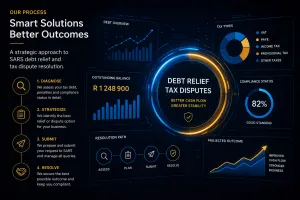
SARS debt relief and dispute remedies for businesses
The right remedy depends on one question: Is the debt correct (accepted), or is the assessment/penalty/interest incorrect (disputed)? SARS provides different mechanisms for each scenario, and mixing them up can waste time and increase exposure.
Comparison of options
| Business situation | SARS remedy route | What it achieves | Key eligibility or governing points | SARS timelines you should plan around |
|---|---|---|---|---|
| You accept the debt, but need time to pay | Payment arrangement (deferral / instalments) | Spreads payment over time, typically with interest still applying | SARS indicates it may enter into an instalment arrangement subject to qualifying criteria, and highlights that all outstanding returns and/or reconciliations must be submitted before it will consider the request; the arrangement must cover the full debt. | SARS does not publish a single universal approval time on the payment-arrangement FAQ; outcomes depend on the case and the completeness of information submitted. |
| You believe SARS raised an incorrect assessment/decision | Request Reasons (where needed) → Objection → Appeal (if required) | Formal review and correction of assessments/decisions (which can reduce or reverse the tax, penalties, and interest driven by an incorrect assessment) | SARS confirms the right to object if you are aggrieved by an assessment/decision; it also flags that you may sometimes request correction first. SARS states an objection must be lodged within 80 business days after the assessment/decision (or after SARS provides reasons where reasons were requested). | SARS service standards on the objections page include: notifying if an objection is invalid within 30 business days, and endeavouring to finalise objections within 60 business days (with stated variations when supporting documents are requested). Appeals must be lodged within 30 business days after the objection outcome (with limited extensions). |
| You intend to dispute, but need breathing room from collections | Suspension of payment (SOP) request (typically alongside or around the dispute) | Can pause SARS collection action for disputed amounts while SARS considers the request and/or while the dispute runs | SARS’s eFiling dispute guide notes SOP is available across major tax types and can be requested as part of (or before/after) disputes; it also states the Request for Reasons and SOP must be submitted within 30 days from the assessment date or certain dispute outcomes. SARS webinar material states SARS will inform you of the SOP decision within 30 business days of receiving complete and accurate supporting documents, and indicates no collection steps from receipt of a valid SOP request until 10 days after you are informed of a decline (or revocation notice). | Submit early and submit complete: SARS ties its SOP decision time to receipt of complete and accurate supporting documents. |
| Penalties or interest were imposed unfairly (or due to resolvable non-compliance) | Request for Remission (RFR) and, if needed, follow the dispute chain | Seeks remission (reduction/removal) of penalties/interest where SARS rules allow it | SARS explains that an RFR can be submitted when disputing an administrative penalty and that the taxpayer must provide reasons. SARS also notes that if an RFR is disallowed or partially allowed, you may still object/appeal. SARS’s eFiling dispute guide explains RFR/NOO/NOA/condonation and lists the tax types covered for administrative penalties and related dispute items. | Timing varies by item; where the RFR forms part of a dispute path, it should be managed alongside the statutory objection/appeal windows. |
| You accept the debt but cannot pay it in full (severe distress cases) | Compromise of tax debt (Section 200 process) and related debt-compromise channels | SARS may agree to accept less than the full amount and write off a portion, if approved | SARS’s own guidance explains that where there is no dispute of liability but the taxpayer cannot pay, SARS may agree to compromise and write off a portion; only a senior SARS official may approve a compromise. SARS also stresses the need for full disclosure and notes SARS need not adhere to a compromise if material facts were not disclosed or were misrepresented. SARS has also published an expedited compromise initiative for qualifying non-disputed debts. | For the expedited process, SARS commits to resolve qualifying applications within four weeks (subject to qualifying criteria, exclusions, and complete accurate documentation). Standard compromise timelines can be longer and case-dependent. |
A practical note on “write-offs” versus “compromises”
From a governance perspective, it helps to separate three concepts often confused in business conversations:
- Payment arrangements: you still pay the full debt (plus applicable interest), just over time.
- Compromise: SARS may permanently write off part of a non-disputed tax debt under an agreement, typically requiring extensive financial disclosure and ongoing compliance conditions.
- Write-off (temporary or permanent): professional guidance summarising the legislation distinguishes between temporary and permanent write-offs and stresses these are SARS decisions governed by Chapter 14 rules; in particular, compromise/write-off provisions generally apply only where the liability is not disputed.
How Admin Boss delivers SARS debt relief and dispute support
Prerequisite: your Public Officer and registered representative must be correctly set up
To move fast and stay compliant, your business needs the right SARS “authority layer” in place:
- SARS describes a registered representative as a person appointed with full rights to act on behalf of a legal entity and notes that where more than one is recorded, one must be nominated as the official “representative person.”
- SARS explicitly warns that section 246 requires a company’s public officer to be a senior official (for example managing director/director/company secretary) and states the public officer is responsible for the company’s tax acts and may be subject to penalties for company defaults.
- SARS’s supporting-document guidance notes that a company typically has a single representative listed across taxes, and that delegation requires a power of attorney for engagement recorded as a once-off mandate.
AdminBoss can assist your business to confirm and fix this setup first (Public Officer/registered representative activation and documentation), because it affects everything that follows.
Process steps
AdminBoss uses a structured approach that mirrors the way SARS evaluates debt and disputes:
- Eligibility and authority check
We confirm your business’s SARS access, nominated representative/public officer status, and the documentation needed to transact. - SARS debt and compliance diagnostic
We assess what is outstanding (tax, penalties, interest, and periods involved), whether returns/reconciliations are outstanding, and where the business is exposed to collection escalation. - Remedy mapping: debt relief, dispute, or both
- If the liability is accepted: we evaluate payment arrangement feasibility and the evidence SARS expects.
- If SARS is wrong: we identify the dispute route (request reasons/correction, objection, appeal) and consider whether a suspension of payment request is necessary to manage collection risk.
- If the business cannot pay in full: we assess whether a compromise is realistic and whether an expedited compromise route may apply (where available and where criteria are met).
- Quote before work begins
After the diagnostic and remedy mapping, AdminBoss issues a written quote aligned to scope (e.g., payment arrangement pack, dispute filing pack, suspension of payment request, compromise application support, follow-ups). - Implementation and follow-through
We prepare submissions, check completeness, support document uploads and correspondence handling, and track SARS outcomes against published service windows where available.
How Our SARS Business Debt Relief Process Works
This process flowchart explains how AdminBoss assists businesses in resolving SARS tax debt. The workflow begins with confirming that the company has a registered Public Officer with SARS, which is required for any tax submissions or disputes. We then review the company’s SARS statements and compliance status to assess the outstanding debt, penalties, and interest. Based on this diagnostic assessment, we determine whether the debt should be addressed through a debt-relief solution such as a payment arrangement or compromise application, or through a formal tax dispute if the assessment is incorrect. The goal is to guide the business from the initial enquiry to a clear resolution and a sustainable compliance plan going forward.
flowchart TD
  A[Initial enquiry from business] --> B[Confirm Public Officer / Registered Representative is in place]
  B -->|Not in place / not active| C[Assist to register or activate Public Officer and collect authority documents]
  B -->|Confirmed| D[Collect SARS statements, notices and return status]
  C --> D

  D --> E[AdminBoss diagnostic assessment: debt, penalties, interest, compliance risk]

  E --> F{Is the SARS liability disputed?}

  F -->|No – debt accepted| G[Select appropriate debt relief route]

  G --> G1[Payment arrangement request]
  G --> G2[Compromise application if severe hardship]

  G1 --> H[Submit request and respond to SARS queries]
  G2 --> H

  F -->|Yes – incorrect assessment| I[Select dispute process]

  I --> I1[Request reasons or correction]
  I --> I2[Submit objection with supporting documents]
  I --> I3[Appeal if objection unsuccessful]
  I --> J[Request Suspension of Payment where required]

  I1 --> H
  I2 --> H
  I3 --> H
  J --> H

  H --> K[Outcome received: revised assessment or agreement]

  K --> L[Close case and implement compliance plan]
What Admin Boss needs from your business

Document checklist for a typical engagement
SARS remedies are evidence-driven. The faster you can provide complete, consistent records, the faster Admin Boss can diagnose and build a submission pack that meets SARS’s “supporting documentation” expectations.
Authority and governance
- Board resolution / letter of appointment for the Public Officer or registered representative (or power of attorney where delegation is used).
- Company registration documents (e.g., Notice of Incorporation; CIPC extracts where relevant).
- IDs and proof of address for the nominated representative, where SARS requires them for updates/verification.
SARS position and correspondence
- Statement(s) of account and latest SARS letters/notices (assessments, penalties, demands).
- Details of any pending audits/verifications and SARS requests for information (if applicable).
Financial evidence for debt relief
- Recent management accounts, cash-flow forecast, and bank statements (especially where affordability, liquidity, or future receipts are relevant for payment terms).
- Aged creditor/debtor listings and key contracts that impact expected income (where relevant).
Evidence for disputes
- Working papers supporting the tax position under dispute (e.g., VAT invoices, payroll reconciliations, contracts, schedules, bank proof, or other source documents supporting the disputed amount and grounds). SARS emphasises that dispute grounds must be detailed and substantiated with documents not previously delivered for the disputed assessment.
Client responsibilities and accuracy
Admin Boss can only build a strong, compliant SARS remedy pack when your business supplies information that is complete, accurate, and consistent.
- SARS has explicitly warned, in the context of its expedited debt-compromise initiative, that applicants must provide comprehensive supporting documentation and that disclosures must be accurate—otherwise SARS may not even consider the application.
- SARS also links key decisions (such as suspension of payment) to receipt of complete and accurate supporting documents, including a stated decision timeline once requirements are met.
- For compromise discussions, SARS guidance stresses honesty and full disclosure, and indicates SARS does not have to adhere to a compromise if material facts were not disclosed or were misrepresented.
By engaging Admin Boss, you confirm that:
- You will provide truthful information and disclose relevant facts, even if unfavourable.
- You will promptly provide requested documents and explanations so statutory and procedural deadlines can be met.
- You understand that SARS outcomes are decision-based and cannot be guaranteed, even with a strong submission.
FAQ for businesses
Do we need a registered Public Officer to start the process?
Yes. SARS specifically expects companies to have a Public Officer who meets section 246 requirements (a senior official, subject to limited exceptions). SARS also treats the registered representative/public officer as the authorised person to act, and the Public Officer carries responsibility for company tax acts and defaults.
Can Admin Boss stop SARS collections while we dispute an incorrect assessment?
A dispute does not automatically remove collection exposure. Where the business intends to dispute the liability, you can apply for suspension of payment (SOP). SARS indicates SOP decisions are communicated within 30 business days once complete and accurate supporting documents are received, and it describes limits on collection steps while a valid SOP request is in play (subject to stated conditions).
How long do we have to object or appeal?
SARS states an objection must be submitted within 80 business days after the date of assessment or decision (or within 80 business days after SARS provides reasons, where reasons were requested). SARS also states an appeal must be lodged within 30 business days after delivery of the objection outcome, with limited extensions available to a senior SARS official.
Can we enter a payment arrangement if we have outstanding returns?
SARS’s payment-arrangement guidance indicates SARS may consider payment arrangements only when non-compliance has been remedied—specifically noting that all outstanding returns and/or reconciliations must be submitted and that the arrangement must cover the entire debt.
Will SARS write off our company’s tax debt?
In severe cases, SARS may agree to compromise (write off a portion) of a non-disputed tax debt, but this requires an approved process and extensive disclosure, and only a senior SARS official may approve a compromise. SARS has also outlined an expedited compromise initiative with strict criteria, exclusions, and strong emphasis on accurate, complete disclosure.
Read more about our tax debt management service.