PAYE Reconciliation (EMP501) for the 202602 Period – What Employers Must Know 📊
If you employ staff in South Africa, you are required to submit a PAYE reconciliation (EMP501) to SARS twice a year. This process confirms that the PAYE, UIF and SDL you declared and paid during the tax period match the payroll information reported to SARS.
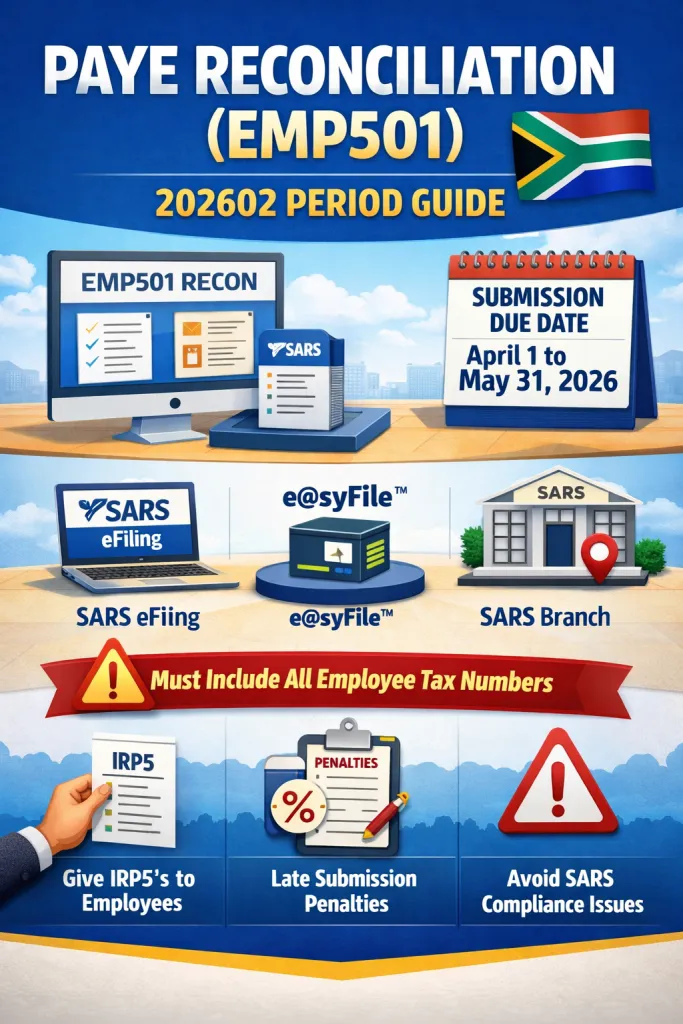
For the 2026 tax year (ending February 2026), employers must complete the annual PAYE reconciliation for the 202602 period. Submitting this reconciliation correctly and on time is essential to avoid penalties and ensure employees can submit their personal tax returns without problems.
📅 Due Date for the 202602 PAYE Reconciliation
The annual EMP501 submission period for the 2026 tax year runs from:
1 April 2026 – 31 May 2026
This reconciliation covers the full payroll period from 1 March 2025 to 28 February 2026.
Employers should submit well before the deadline to avoid last-minute system issues or validation errors.
📄 What Is a PAYE Reconciliation (EMP501)?
A PAYE reconciliation (EMP501) is a process where employers compare and confirm three sets of information submitted to SARS:
- Monthly payroll declarations (EMP201)
- PAYE, UIF and SDL payments made to SARS
- Employee tax certificates (IRP5/IT3(a))
All three must match for the reconciliation to be accepted.
During the process, employers submit:
- EMP501 reconciliation declaration
- IRP5 or IT3(a) tax certificates for employees
- Any corrections needed for payroll values
This ensures SARS has accurate payroll information before individual tax filing season begins.
💻 Which Channels Can Be Used to Submit EMP501?
SARS provides several submission options depending on the size of the employer:
1️⃣ SARS eFiling
Employers with 50 or fewer employees can submit their EMP501 directly through SARS eFiling.
2️⃣ SARS e@syFile™ Employer
This software is commonly used by payroll administrators and is required for employers with more than 50 employees.
3️⃣ SARS Service Centres
Very small employers with only a few certificates may visit a SARS branch for assistance (appointment required).
Most businesses today submit using eFiling or e@syFile Employer software.
⚠️ Important Update: Income Tax Numbers Required for All Employees
From the 202602 reconciliation period, SARS has tightened validation rules.
Submissions may be rejected if employees do not have personal income tax numbers captured on their IRP5 certificates.
Employers must therefore:
- Ensure all employees are registered for income tax
- Capture the correct tax number on the IRP5
- Update payroll records before generating certificates
If tax numbers are missing, the reconciliation submission may fail validation and delay the filing process.
📑 Why IRP5 Copies Must Be Given to Employees
Once the EMP501 reconciliation has been successfully submitted and accepted by SARS, employers must issue IRP5 or IT3(a) certificates to employees.
These documents are important because they:
✔ Allow employees to submit their personal income tax returns (ITR12)
✔ Show the salary earned and tax deducted during the year
✔ Allow SARS to auto-populate income tax returns
✔ Help employees claim deductions or refunds
Without the IRP5 certificate, employees may struggle to complete their tax returns correctly.
🚨 What Happens If the EMP501 Is Not Submitted?
Failure to submit the reconciliation can have serious consequences.
Possible penalties include:
Administrative penalties
- SARS can charge penalties starting at 1% of annual PAYE liability, increasing monthly up to 10%.
Compliance issues
- The employer may be flagged as non-compliant with SARS.
Employee tax problems
- Employees may not receive valid IRP5 certificates and could experience delays with their personal tax returns.
Submitting your EMP501 on time helps keep your business compliant and avoids unnecessary penalties.
✅ Tips to Prepare for EMP501 Submission
To ensure a smooth reconciliation process:
✔ Reconcile all EMP201 submissions with payroll reports
✔ Confirm that all PAYE payments were made
✔ Verify employee tax numbers
✔ Update employee details such as ID numbers and addresses
✔ Generate IRP5 certificates from your payroll system
Doing these checks early can save significant time when filing season opens.
👍 Need Help with Your PAYE Reconciliation?
Many small businesses struggle with payroll reconciliations and SARS validation rules. Getting professional assistance can help ensure:
- Accurate EMP501 submission
- Correct IRP5 certificates
- Compliance with SARS requirements
- No unnecessary penalties
A reliable and affordable tax service can handle the process so you can focus on running your business.
PAYE Reconciliation (EMP501) – Frequently Asked Questions
What is a PAYE reconciliation (EMP501)?
A PAYE reconciliation (EMP501) is a declaration submitted by employers to SARS that reconciles the payroll taxes declared during the tax year. It compares the monthly EMP201 submissions, PAYE payments made to SARS, and employee tax certificates (IRP5/IT3(a)) to ensure the information matches. This reconciliation confirms that the correct taxes were deducted and paid for employees.
When is the PAYE reconciliation due for the 202602 period?
The EMP501 reconciliation for the 202602 period must be submitted between 1 April 2026 and 31 May 2026. This reconciliation covers the payroll period from 1 March 2025 to 28 February 2026. Employers should submit before the deadline to avoid SARS penalties and compliance issues.
How do employers submit the EMP501 reconciliation?
Employers can submit the PAYE reconciliation using the following SARS channels:
- SARS eFiling – suitable for smaller employers with fewer employees
- SARS e@syFile™ Employer software – commonly used by payroll administrators and larger employers
- SARS branch offices – available in limited situations where electronic submission is not possible
Most businesses submit their reconciliation using SARS eFiling or e@syFile Employer software.
What happens if an employer does not submit the EMP501?
If the PAYE reconciliation is not submitted on time, SARS may impose administrative penalties and interest. The penalty can start at 1% of the employer’s annual PAYE liability and increase monthly up to 10%. Non-submission can also result in compliance issues with SARS and delays in issuing employee tax certificates.
Do employees need tax numbers for the 202602 reconciliation?
Yes. From the 202602 reconciliation period, SARS validation rules require that all employees have personal income tax numbers captured on their IRP5 certificates. If employee tax numbers are missing, the EMP501 submission may fail validation and be rejected by SARS.
Why must employers give IRP5 certificates to employees?
Employers must provide employees with IRP5 or IT3(a) certificates after the PAYE reconciliation is submitted. These certificates allow employees to:
- Complete their personal income tax returns (ITR12)
- Confirm the salary earned and tax deducted
- Allow SARS to pre-populate tax returns with payroll information
Without an IRP5 certificate, employees may have difficulty submitting their tax returns correctly.
What information is required for an EMP501 submission?
To complete the PAYE reconciliation, employers must submit:
- The EMP501 reconciliation declaration
- IRP5 or IT3(a) tax certificates for all employees
- Correct totals for PAYE, UIF, and SDL
- Payroll information that matches EMP201 submissions and payments
Ensuring these figures match is essential for successful submission.
Can a PAYE reconciliation be corrected after submission?
Yes. If an error is discovered after submission, employers can submit a revised EMP501 reconciliation through SARS eFiling or e@syFile Employer. Corrections may include updating payroll values, employee details, or tax certificate information.