How Artificial Intelligence Will Impact Small Businesses in South Africa 🤖🚀
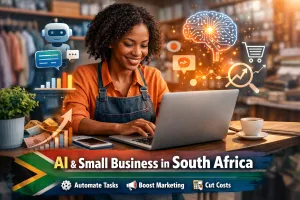
Artificial intelligence is no longer something only big corporations talk about. It is already changing how businesses write content, respond to customers, manage admin, analyse data, and sell online. For small businesses in South Africa, this shift could be a major advantage — especially for owners who need to do more with less. At the same time, the impact will not be equal for everyone. Businesses with better internet access, stronger digital skills, and a willingness to adapt will be in a much better position to benefit. South Africa’s digital environment is improving, but access remains uneven, and the region still faces challenges around connectivity, device costs, and cybersecurity.
🤖 Why AI matters for South African small businesses
Small businesses already play a major role in South Africa’s economy. Stats SA says small businesses generated 21% of turnover in formal business activity in 2023, and they remain important employers across sectors such as food and beverages, accommodation, motor trade, wholesale trade, and construction. In the informal economy, many businesses also struggle with marketing, operating space, and licensing — all areas where AI-assisted tools can help streamline work and improve visibility.
AI matters because it can help small business owners save time on repetitive work and focus on revenue-generating tasks. OECD research shows that generative AI is already helping firms automate cognitive tasks, improve productivity, and strengthen marketing and customer relations. It also notes that the benefits can be especially strong for lower-skilled or less-experienced workers, while full automation of complete jobs is not yet an immediate risk.
💡 How AI can help small businesses grow faster
AI can support small businesses in very practical ways. It can write first drafts of social media captions, email replies, product descriptions, and blog posts. It can help answer common customer questions faster through chat tools, which is useful for businesses that do not have a full-time support team. It can also help owners analyse sales patterns, forecast demand, and make smarter decisions about stock, pricing, and promotions. The OECD notes that SMEs are increasingly using AI to automate tasks, expand their customer base, and improve efficiency, while cloud-based AI tools have lowered the entry barrier for smaller firms.
For South African businesses, this is especially important because digital adoption is still uneven. The World Bank says digitalisation in Eastern and Southern Africa is held back by limited internet coverage, high data costs, weak infrastructure, and cybersecurity risks. In South Africa, 76% of people were using the internet in 2023, which means many customers are reachable online, but not all communities are equally connected.
⚠️ The real challenges: skills, trust, and access
AI is powerful, but it is not magic. Many small businesses will struggle to benefit if they do not have stable connectivity, basic digital skills, or a clear plan for how to use the tools. South Africa’s Department of Communications and Digital Technologies has also stressed that connectivity alone is not enough; it says digital skills are essential, and in 2025/26 it plans to train 12,000 SMMEs in digital entrepreneurship, including e-commerce, digital marketing, and online transactions. The department also released a National AI Policy Framework in October 2024, showing that AI is becoming a serious policy issue in South Africa, not just a trend.
There is also a trust issue. AI tools can produce errors, generic content, or biased outputs if they are used carelessly. That means small business owners should treat AI as a helper, not a replacement for judgment. The smartest businesses will use AI to speed up routine work while keeping a human voice, a real brand personality, and proper quality control. OECD research shows that AI is most valuable when work is redesigned to take advantage of its strengths instead of trying to let it run everything on its own.
🛠️ How small business owners can use AI to their advantage
Small business owners can use AI to save time, reduce stress, and make better decisions by starting with simple, low-risk tasks. For example, AI can help draft WhatsApp replies, create social media content, summarise customer feedback, suggest blog ideas, organise supplier notes, and improve basic marketing copy. It can also help a business owner think faster by turning rough ideas into structured plans. The best approach is to begin with one task, test the result, and keep what works. That way, AI becomes a practical assistant that helps the business grow without replacing the human side that customers still trust. This is especially relevant in South Africa, where many SMEs need to increase efficiency, expand their customer base, and compete with larger businesses while working with limited time and resources.
📈 The businesses most likely to win
The businesses that benefit most from AI will usually be the ones that combine technology with strong execution. That means:
- fast replies to customers,
- better content creation,
- smarter budgeting,
- cleaner admin systems,
- and more consistent online visibility.
AI will not replace good service, strong products, or trust. But it can help make those strengths easier to deliver at scale. In South Africa’s current environment — where small businesses matter, digital access is improving but uneven, and government attention to AI is increasing — early adopters are likely to gain a clear edge.
🚀 Real-Life Scenario: How Thabo Used AI to Grow His Small Business
Thabo runs a small plumbing and maintenance company in Pretoria. Like many small business owners in South Africa, he started his business with limited resources. Most of his work came from word of mouth, and he handled everything himself — answering customer calls, writing quotes, managing appointments, and keeping track of payments. Many evenings were spent doing paperwork instead of spending time with his family.
One of Thabo’s biggest challenges was responding quickly to new customer enquiries. If he missed a call or took too long to reply to a WhatsApp message, the customer would often contact another plumber. Writing quotes also took time, and sometimes his messages looked rushed or unprofessional because he was busy on-site doing physical work.
This is where artificial intelligence began to make a difference.
Thabo started using AI tools to help him handle the admin side of his business. With the help of AI, he could generate professional quote templates, draft quick but clear WhatsApp responses to customer questions, and even create simple Facebook posts advertising his services. Tasks that used to take him hours now took only a few minutes.
AI also helped him analyse his business activity. By looking at his job history, Thabo realised that emergency geyser repairs and burst pipe call-outs were his most profitable services. With that insight, he began focusing his marketing on those specific services instead of advertising everything he offered.
Within a few months, the results were clear. Customers received faster responses, his quotes looked more professional, and his online posts attracted new enquiries. Thabo was still doing the same physical work, but the way he managed his business had changed completely. Instead of feeling overwhelmed by admin, he had more time to focus on serving customers and growing his company.
This simple shift shows how artificial intelligence can become a powerful assistant for small business owners in South Africa. When used correctly, AI does not replace the entrepreneur — it helps them operate more efficiently, look more professional, and compete with larger businesses.
🚀 Launch Your Professional Business Website in Days — Not Months
Admin Boss can help you get online fast with a custom-built 3-page WordPress website designed for South African small businesses — including a Home page, an About/Services page, and a Contact page with an enquiry form — plus a .co.za domain, SSL security, six months of hosting, and basic SEO setup so your business is ready to be found on Google and AI search tools. That means you are not just getting a website; you are getting a professional online presence that builds trust, brings in enquiries, and gives your business a proper digital home without the stress of trying to figure it all out yourself. With fast turnaround times of about 1–10 business days depending on content readiness and domain setup, this is the kind of move that lets you stop losing customers to businesses that already look more established online.
Get your 3-page website built now before another customer moves on.

Frequently Asked Questions
How can artificial intelligence help small businesses in South Africa?
Artificial intelligence can help small businesses save time, improve customer service, create marketing content, manage admin faster, and make better business decisions.
Do small businesses need technical skills to use AI?
No. Many AI tools are designed to be simple and beginner-friendly. A small business owner can start with basic tasks like writing messages, creating quotes, or planning social media posts.
What is the biggest benefit of AI for a small company?
The biggest benefit is efficiency. AI helps small companies do more in less time, which can improve productivity, reduce stress, and make the business look more professional.
✅ Final thoughts
Artificial intelligence will have a real impact on small businesses in South Africa. For some owners, it will mean faster marketing, less admin, and better customer service. For others, it may feel intimidating at first. But the businesses that learn how to use AI early will likely be better positioned to save time, improve efficiency, and stay competitive in a changing market. The future belongs to small businesses that stay human, stay agile, and use technology wisely.