How to Deregister Your Company in South Africa (2026 Guide)
Closing a company the right way is just as important as registering one. If your business has stopped trading, is dormant, or simply no longer serves a purpose, leaving it on the CIPC register without filing annual returns can lead to forced deregistration, frozen bank accounts and personal liability headaches down the line. This guide walks you through the complete, official process of how to deregister your company in South Africa — at both the Companies and Intellectual Property Commission (CIPC) and the South African Revenue Service (SARS) — in five clear steps.
What Does It Mean to Deregister a Company?
Deregistration means your company is formally removed from the CIPC companies register. Once the status shows “Final Deregistered”, the company no longer exists as a legal entity. It cannot trade, sign contracts, own assets, sue or be sued — and its bank accounts and assets are frozen. That is why it is critical to settle everything with SARS before you apply, and why a company that still has assets or outstanding liabilities should rather be liquidated through the formal CIPC process instead.
Voluntary deregistration is available to any business that has ceased all business operations and has no assets, or whose assets are so inadequate that there is no reasonable probability of liquidation — including companies that never traded and have no outstanding liabilities. If the process is done properly, it is a clean, low-cost exit. If it is ignored, CIPC will eventually deregister the company automatically for non-compliance, which can cause serious problems if the company still holds assets or contracts.
The Process Is the Same for Every Company Type
One of the most common questions we get at Admin Boss is whether close corporations or NPCs follow a different route. They do not. The five-step deregistration process below applies in exactly the same way to:
- Private companies (Pty) Ltd — the most common small business structure in South Africa.
- Close corporations (CC) — the older, member-owned structure. Even CC member changes must be up to date before you apply.
- Non-profit companies (NPC) — including voluntary associations that registered as NPCs.
- Personal liability companies (Inc) — often used by professional practices such as attorneys and accountants.
Whichever structure you have, you will deal with the same two institutions — CIPC for the company itself, and SARS for every registered tax type. The only difference between entities is which people sign the consent documents: directors for companies, and members for close corporations.
How to Deregister Your Company: The 5-Step Process
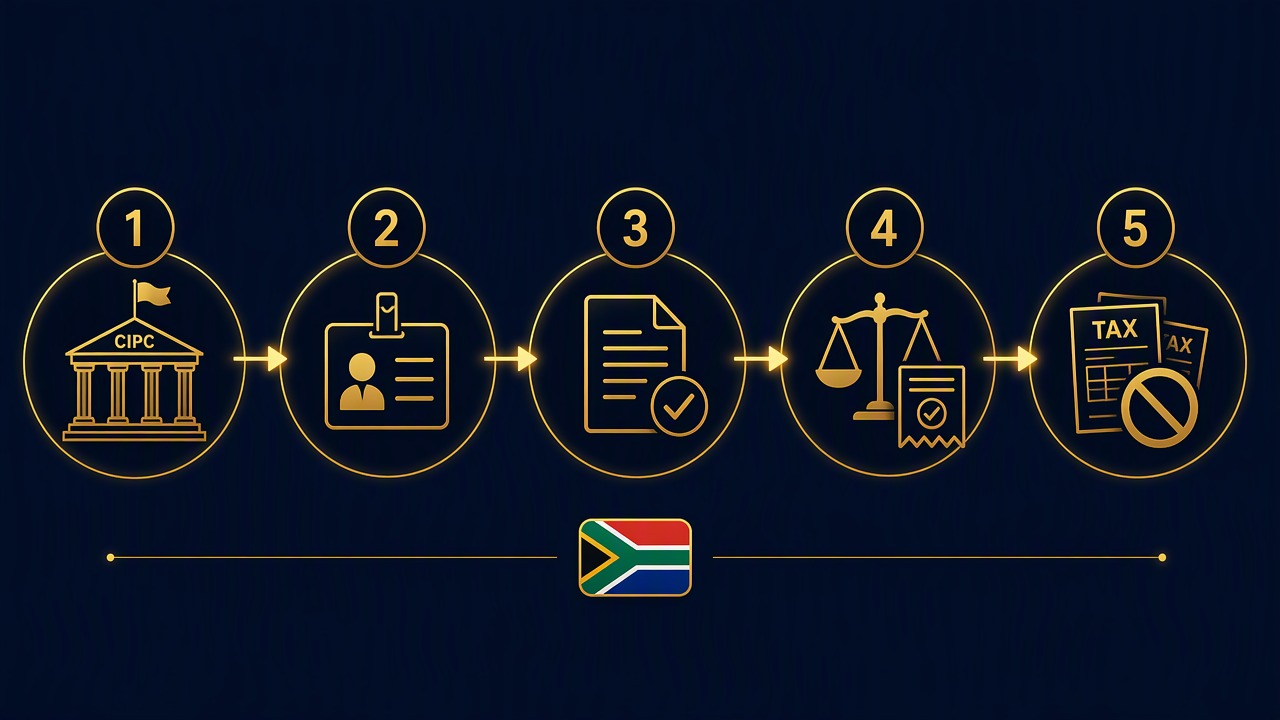
Follow these steps in order. Skipping one — especially the SARS ones — is the main reason deregistration applications get rejected or stall for months.
Step 1 — Deregister the Company at CIPC
Start at the CIPC. A company or close corporation may apply for voluntary deregistration only if it has ceased all business operations and has no assets — or its assets are inadequate with no reasonable probability of liquidation. The application is lodged on BizPortal (CIPC’s official digital platform) or by emailing a signed request to .
What CIPC requires from you
- A letter confirming the company is not carrying on business or is dormant, and has no assets or inadequate assets with no reasonable probability of liquidation.
- The letter signed by at least 50% of the active directors (or members, in the case of a CC).
- Certified ID copies of the signing directors or members.
- Written confirmation from SARS that no tax liability is outstanding (your Tax Compliance Status or tax clearance) — this is why Steps 2 to 4 below come first.
- The company’s tax number, if available, and all CIPC annual returns filed and paid up.
Important: if your Beneficial Ownership declaration is outstanding, your annual returns will be blocked — and outstanding annual returns block deregistration entirely. Fix those first.
Step 2 — Make Sure the Company Has a Public Officer at SARS
Every registered company must have a Public Officer — a natural person appointed as the company’s official representative at SARS. SARS will not process registrations, returns, compliance status requests or deregistrations for a company without an active, registered Public Officer. If your company was registered years ago and the Public Officer has resigned, emigrated or passed away, that appointment must be updated before anything else can move.
How to check and fix it
Log in to SARS eFiling and confirm who is listed as the Public Officer and that their details are current. If no Public Officer is registered — or the wrong person is listed — the appointment must be corrected first. Admin Boss handles Public Officer appointments as part of its business compliance services if you would rather hand this over.
Step 3 — Submit All Outstanding Returns (Even If the Company Never Traded)
This is the step most business owners get wrong. “Never traded” does not mean “no returns due.” As long as the company’s income tax reference number is active at SARS, an income tax return (ITR14) is expected every year — and SARS issues administrative penalties for non-filing, even at nil turnover. If the company was registered for VAT, PAYE, SDL or UIF at any point, returns are due for those too (VAT201, EMP201 and the annual EMP501 reconciliation).
What to file before deregistration
- All outstanding ITR14 company income tax returns, even nil returns.
- All outstanding VAT201 returns if the company was a VAT vendor.
- All outstanding EMP201 monthly employer returns and the EMP501 reconciliations if the company ever registered as an employer.
- Provisional tax (IRP6) returns where applicable.
Filing every missing year first also stops further penalties from accumulating. If your books are a mess, our free business tools — including the Business Compliance Dashboard — help you see exactly what is outstanding, and Admin Boss can catch up multiple outstanding years in one go.
Step 4 — Make Sure There Is No Outstanding Tax Debt
CIPC will not finalise a deregistration without written SARS confirmation that no tax liability is outstanding, and SARS will not deregister a tax type while debt is on the account. Request your Tax Compliance Status (TCS) on eFiling and deal with anything it flags: outstanding returns, unpaid tax, or penalties and interest.
If you cannot pay in full
If the company owes SARS money it genuinely cannot pay, do not ignore it — an installment payment arrangement or compromise can bring the account into good standing. If the company is insolvent rather than just dormant, deregistration is not the right route at all; speak to a professional about liquidation instead. Admin Boss offers SARS debt management for companies when the numbers need untangling.
Step 5 — Deregister All Tax Types at SARS
A CIPC deregistration does not automatically close the company’s tax affairs at SARS — a common and costly misconception. Each registered tax type must be deregistered separately, and for the income tax reference itself, SARS requires the CIPC notice of deregistration as supporting documentation.
How each tax type is deregistered
- Log in to SARS eFiling and go to Registration Maintenance to request deregistration per tax type.
- VAT — complete and submit the VAT123e form (the date the business ceased trading is mandatory).
- PAYE / SDL / UIF — complete and submit the EMP123 form or the written notification on eFiling.
- Income tax — submit the request with the CIPC deregistration notice attached.
- Keep the SARS confirmation for each deregistered tax type with the company’s final records.
For UIF-specific deregistration and contributor questions, our sister site UIF South Africa has dedicated guides, and Private Company SA covers the broader company lifecycle from registration to closure.
Real-Life Scenario: The Dormant CC That Wouldn’t Die
Thandi registered a close corporation in 2019 to run a weekend events business. She ran two events, made a small profit, and then life took over — the CC never traded again. She never filed CIPC annual returns, never filed a SARS return (“I never made money, so why would I?”), and never appointed a Public Officer after her cousin — the original one — moved to New Zealand.
In 2025 she got a letter from her bank: the CC’s account was flagged because the entity appeared in a CIPC deregistration gazette. When she checked on BizPortal, the status read “AR Deregistration Process.” Worse, SARS had issued years of non-filing penalties, and because there was no active Public Officer, nothing could be fixed online.
Because she acted before final deregistration, Thandi could still rescue the situation properly: she appointed a new Public Officer, filed all outstanding nil returns, paid the small accumulated penalties, submitted outstanding annual returns, and only then applied for voluntary deregistration — this time on her terms, with a clean SARS record. Had she waited until “Final Deregistered,” and the CC still held the brand name she wanted to reuse, she would have needed a formal reinstatement instead. The lesson: deregister on your own terms, while you still control the process.
How Long Does Company Deregistration Take?
CIPC’s voluntary deregistration is a two-step process. First, the deregistration request is processed (about 4 working days from tracking). Then a notice of pending deregistration is issued to all directors or members and other stakeholders, who have an objection window of roughly four months before final deregistration. Since August 2025 these notices are sent by email only, so make sure the contact details on the CIPC register are current — CIPC cannot be held liable if notices go to an old email address. Track the status at any time via the BizProfile section on BizPortal.
The SARS side moves on its own timeline: once fully compliant, deregistering each tax type typically takes several months to finalise. Start the SARS cleanup early — it is almost always the longest part of the process.
What If Your Company Was Already Deregistered?
If your company shows “Final Deregistered” but you still need it — because it owns property, holds a contract, or you want to trade under its name again — it can be reinstated with a CoR40.5 application, but only if it was in business or had other economic value at the time of deregistration. Our company reinstatement service handles the full process, including the outstanding annual returns needed to bring the company back to “In Business” status.
Frequently Asked Questions About Company Deregistration
1. How much does it cost to deregister a company in South Africa?
The voluntary deregistration request itself carries no CIPC filing fee — it is submitted by email to or through BizPortal. The real costs are everything needed to become compliant first: outstanding annual return fees to CIPC, any accumulated SARS administrative penalties, and professional fees if you use a service provider such as Admin Boss to handle the paperwork.
2. How long does it take to deregister a company?
From the day your affairs are fully compliant, expect roughly 4 working days for CIPC to process the request, followed by an objection window of about four months before final deregistration. Deregistering the tax types at SARS is a separate process that can take several additional months. In practice, most properly prepared deregistrations are fully concluded within 3 to 6 months.
3. Can I deregister a company that has outstanding tax debt?
No. CIPC requires written confirmation from SARS that no tax liability is outstanding before it will finalise the deregistration, and SARS will refuse to deregister a tax type while debt remains on the account. All returns must be filed, and all tax, penalties and interest must be settled — or a formal payment arrangement put in place — before the process can be completed.
4. My company never traded — do I really still have to file SARS returns?
Yes. While a company’s income tax reference number is active at SARS, an annual ITR14 return is expected — and SARS charges administrative penalties for non-filing even when the company earned nothing. “Dormant” is not a filing exemption. The only way to stop the annual obligation is to file everything outstanding and then deregister the tax reference number itself.
5. What happens if I do nothing and just stop filing?
CIPC automatically refers companies and CCs for deregistration when two or more successive annual returns are outstanding. The company is published in the Government Gazette, and if nothing is filed, it is finally deregistered — freezing bank accounts, voiding contracts and creating serious complications if any assets remain. SARS also keeps issuing non-filing penalties and can pursue the Public Officer. Doing nothing is the most expensive option of all.
Ready to Close Your Company the Right Way?
Deregistering a company is very doable on your own — but one missed return or an outdated Public Officer can stall the process for months. Admin Boss handles company deregistrations, SARS tax deregistrations, Public Officer appointments and catch-up filings remotely, anywhere in South Africa.
Need More Info? Speak to Admin Boss →
WhatsApp 074 918 7130 or email — nationwide, fully remote.

